![]() |
| Burial place of Isaac Griffith in Bradley County, TN. |
This blog is an archive of "Artifact of the Week" posts as featured on the Museum of Scott County Facebook page
Thursday, May 31, 2018
Civil War Cannon Shell
This Civil War cannon shell, on display at the museum, was found in
Scott County. Not to be confused with a cannon ball which is solid on
the inside, hollow shells like these were used against enemy forces by
exploding into shrapnel when fired from a cannon. Isaac Griffith, one
of the few men from Scott County to fight for the Confederacy,
remembered in his 79th year his experience with a shell like this. "On
our return through the (Cumberland) Gap
wee campd at Tasville at the last of October in the morning the snow was
about 5 inceas deep, when wee was getting beakfast some fool picked up a
bomb shell and had it for a dog iron. It exsploed and killed three
men."
Information taken from 1915 Confederate Veteran's Questionnaire completed by Isaac Griffith. Photo two taken from a First National Bank Chronicle article about the Griffith Family FNB Chronicle Vol. 6 No. 3 Spring of 1995. Photo three courtesy of findagrave.com.
Native American Cooking Pot
This woodland-era pot, dating to 2,000 years ago, was used by early
Native Americans as a cooking pot. It was excavated by students in the
Anthropology class at Scott High School. The students found 75% of the
pot and sent it to the University of Tennessee to have it carbon-dated
and reassembled. Not all of the pieces were found, as evidenced by the
modern clay used to fill up the holes in the pot. The woodland era
began around 1,000 B.C. and ended 1,000
A.D. Pottery during this time period is very simple and has
check-stamping instead of handles. Check stamping is when the Native
Americans would take a vine-wrapped paddle and would put indentations
into the wet clay used to grip the finished pot when it was greasy or
wet.
Information and pictures two and three taken from Tribes That Slumber by Lewis and Madeline Kneburg
![]() |
| Detail showing check stamping on the pot displayed at the museum. |
![]() |
| Drawing
from the book Tribes That Slumber which is published by the University
of Tennessee. The drawing shows a pot similar to the one at the museum. |
![]() |
| Drawing from the book Tribes That Slumber published by the University of Tennessee. This drawing shows how Native Americans manufactured pots similar to the one found in Scott County. |
![]() |
| Various forms of check stamping found on pots from the Woodland Era. |
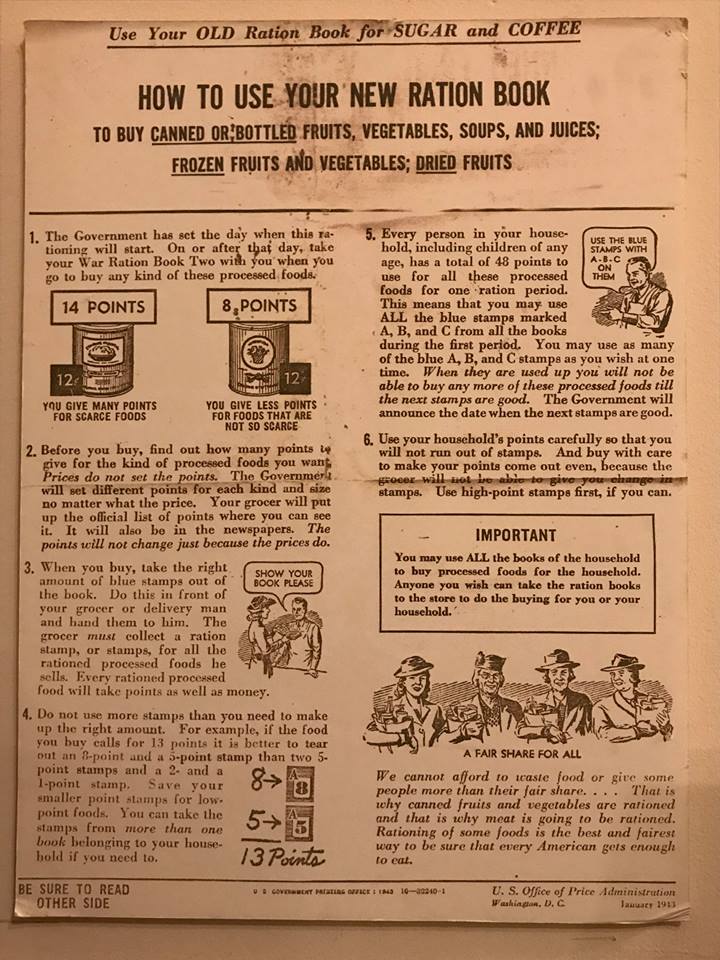
WWII Ration Book
Ration books containing stamps like these were issued to civilians on
the home front during the second world war. After the attack on Pearl
Harbor, the U.S. Government began rationing goods so that there was
plenty of material to send to the fighting men across the ocean. These
books were issued to citizens and contained stamps that rationed out how
much food, gasoline, and tires a family was allotted. These stamps did
not pay for the goods, like food stamps, but allowed every family to get a fair share of rationed items.
![]() |
| Ration books like these were used by civilians during WWII to claim their portion of rationed goods. |
![]() |
| This ration stamp for sugar ensured that it was only being used for home canning of fruit and required a signature. |
![]() |
| Ration stamps for coffee. |
![]() |
| Poster explaining how to use ration stamps when purchasing goods. |
Joy Dirksen Baker's Wedding Dress
Danice Joy Dirksen Baker, daughter of Everett and Louella Dirksen,
married Howard Henry Baker Jr. on December 22, 1951. She wore a
Marshall Fields original wedding gown with matching kidskin gloves.
Although overshadowed by her husband's illustrious political career, Joy
Baker served on influential committees for Knoxville College, the
Kennedy Center or Performing Arts, and Ford's Theater, receiving a
Lincoln Medal in 1985 for her work at
Ford's Theater. She died on April 24, 1993 and was buried in the Mossop
Cemetery adjacent from the First Presbyterian Church in Huntsville, TN.
Photographs 3 and 4 courtesy of findagrave.com
![]() |
| his Marshall Fields wedding gown was worn by Joy Dirksen Baker when she married future senator Howard H. Baker Jr. |
![]() |
| Matching kidskin gloves |
![]() |
| Howard H. Baker Jr. and Joy Dirksen Baker on their wedding day December 22, 1951. |
![]() |
| Joy Baker and her husband at a political rally. Their son Derek can be seen behind Joy and their daughter Cissy can be seen to the right of Howard. |
![]() |
| The resting place of Howard Henry Baker Jr. and wife Joy Dirksen Baker at the Mossop Cemetery in Huntsville, Tennessee. |
Baby Cradle
This beautiful baby cradle was handmade around 1912. The corners are
dovetailed, which is one of the strongest joints used in carpentry. The
cradle includes intricate carving on the headboard and graceful
rockers. Hand forged iron brackets, made in a blacksmith shop, hold the
rockers onto the cradle. The rockers extend beyond the width of the
cradle so that the mother could use her foot to rock the cradle leaving
her hands free to complete other tasks.
Congressional Medal of Honor Citation
This citation for the Congressional Medal of Honor, the highest honor
that can be bestowed on an American in combat by the President, was
issued to First Lieutenant Joseph Cecil of New River, TN. Cecil was
serving at Bud-Dajo located in the Philippine Islands during the
Philippine Insurrection, an offshoot of the Spanish American War. On
March 7, 1906 while at the head of a column of soldiers, Cecil carried a
wounded comrade to a sheltered position
and retrieved the body of another comrade. Cecil was awarded the Medal
of Honor by President Calvin Coolidge. Joseph Cecil rose to the rank
of colonel and served in WWI. He died in 1940 and is buried in
Arlington National Cemetery. Colonel Joe Cecil Bridge, spanning New
River, is named for him. The whereabouts of his Medal of Honor are not known.
Note: his citation gives his name as Josephus Cecil
Photos of Cecil, Congressional Medal of Honor, Tombstone, and bridge sign courtesy of findagrave.com
Note: his citation gives his name as Josephus Cecil
![]() |
| This citation was issued to Joseph Cecil, native of Scott County, upon his reception of the Congressional Medal of Honor. |
![]() |
| Col. Joseph Cecil |
![]() |
| This style of the Congressional Medal of Honor is the one that Joseph Cecil received for his service in the Philippine Insurrection. The whereabouts of his medal are not known. |
![]() |
| Joseph Cecil's Tombstone in Arlington National Cemetery. |
![]() | ||
| This bridge, spanning New River in south Scott County, is named for Col. Joseph Cecil. |
Battleship USS Tennessee Bell
This bell, which can be viewed at the museum, was fitted aboard the
battleship USS Tennessee when she was constructed before 1920. When the
ship was commissioned, the United States Navy labored hard to enlist
the majority of the sailors from Tennessee, a feat that had never been
attempted. When the Tennessee entered service, 95% of her crew were
from the state that she was named after. The ship was commissioned too
late to be involved in WWI and spent
most of its early years traveling the globe. Later she was docked at
Pearl Harbor, Hawaii. She was placed beside the USS Arizona and this is
where she was found on December 7th, 1941 when the Japanese attacked.
The Tennessee served continually until 1943 when she was taken to
Washington state to be repaired, fitted with new guns, and given a new
bell. The bell that is featured was taken out of storage after many
years and placed here in front of the Battleship USS Tennessee Museum.
Her sister bell can be found at the Tennessee State Military Museum in
Nashville.
Note: A video of the second bell can be found here at 1:40. Second USS Tennessee Bell
Subscribe to:
Posts (Atom)