Thursday, May 31, 2018

Native American Cooking Pot

This woodland-era pot, dating to 2,000 years ago, was used by early Native Americans as a cooking pot. It was excavated by students in the Anthropology class at Scott High School. The students found 75% of the pot and sent it to the University of Tennessee to have it carbon-dated and reassembled. Not all of the pieces were found, as evidenced by the modern clay used to fill up the holes in the pot. The woodland era began around 1,000 B.C. and ended 1,000 A.D. Pottery during this time period is very simple and has check-stamping instead of handles. Check stamping is when the Native Americans would take a vine-wrapped paddle and would put indentations into the wet clay used to grip the finished pot when it was greasy or wet.


Detail showing check stamping on the pot displayed at the museum.

Drawing from the book Tribes That Slumber which is published by the University of Tennessee. The drawing shows a pot similar to the one at the museum.

Drawing from the book Tribes That Slumber published by the University of Tennessee. This drawing shows how Native Americans manufactured pots similar to the one found in Scott County.

Various forms of check stamping found on pots from the Woodland Era.
Information and pictures two and three taken from Tribes That Slumber by Lewis and Madeline Kneburg 

WWII Ration Book

Ration books containing stamps like these were issued to civilians on the home front during the second world war. After the attack on Pearl Harbor, the U.S. Government began rationing goods so that there was plenty of material to send to the fighting men across the ocean. These books were issued to citizens and contained stamps that rationed out how much food, gasoline, and tires a family was allotted. These stamps did not pay for the goods, like food stamps, but allowed every family to get a fair share of rationed items.

Ration books like these were used by civilians during WWII to claim their portion of rationed goods.


This ration stamp for sugar ensured that it was only being used for home canning of fruit and required a signature.

Ration stamps for coffee.

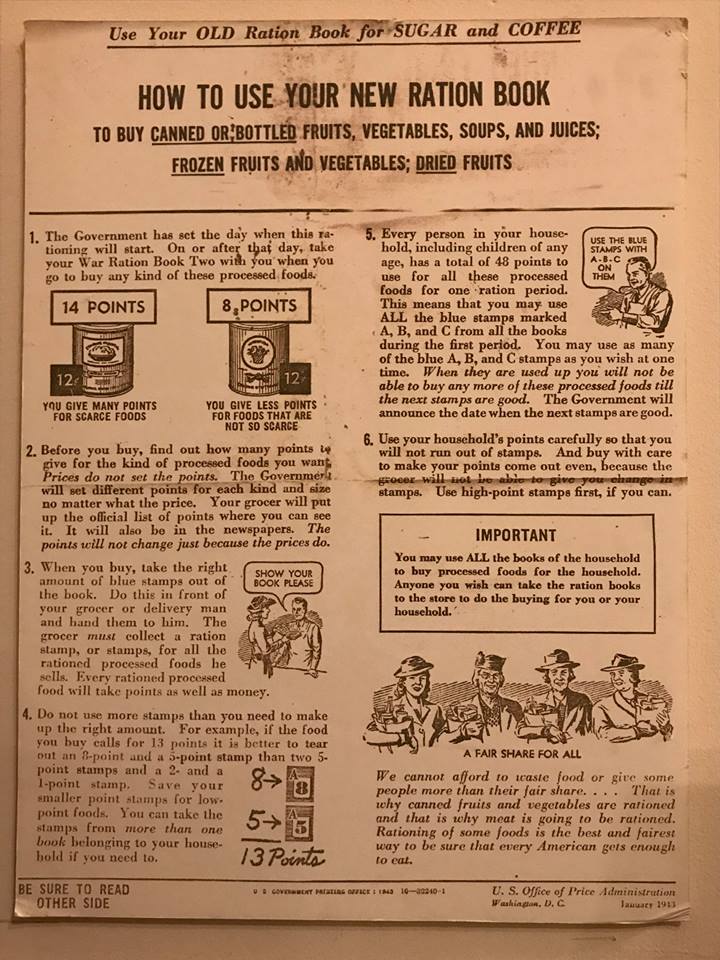
Poster explaining how to use ration stamps when purchasing goods.

Joy Dirksen Baker's Wedding Dress

Danice Joy Dirksen Baker, daughter of Everett and Louella Dirksen, married Howard Henry Baker Jr. on December 22, 1951. She wore a Marshall Fields original wedding gown with matching kidskin gloves. Although overshadowed by her husband's illustrious political career, Joy Baker served on influential committees for Knoxville College, the Kennedy Center or Performing Arts, and Ford's Theater, receiving a Lincoln Medal in 1985 for her work at Ford's Theater. She died on April 24, 1993 and was buried in the Mossop Cemetery adjacent from the First Presbyterian Church in Huntsville, TN. 

his Marshall Fields wedding gown was worn by Joy Dirksen Baker when she married future senator Howard H. Baker Jr.

Matching kidskin gloves

Howard H. Baker Jr. and Joy Dirksen Baker on their wedding day December 22, 1951.

Joy Baker and her husband at a political rally. Their son Derek can be seen behind Joy and their daughter Cissy can be seen to the right of Howard.

The resting place of Howard Henry Baker Jr. and wife Joy Dirksen Baker at the Mossop Cemetery in Huntsville, Tennessee.
 Photographs 3 and 4 courtesy of findagrave.com

Baby Cradle

This beautiful baby cradle was handmade around 1912. The corners are dovetailed, which is one of the strongest joints used in carpentry. The cradle includes intricate carving on the headboard and graceful rockers. Hand forged iron brackets, made in a blacksmith shop, hold the rockers onto the cradle. The rockers extend beyond the width of the cradle so that the mother could use her foot to rock the cradle leaving her hands free to complete other tasks.


Congressional Medal of Honor Citation

This citation for the Congressional Medal of Honor, the highest honor that can be bestowed on an American in combat by the President, was issued to First Lieutenant Joseph Cecil of New River, TN. Cecil was serving at Bud-Dajo located in the Philippine Islands during the Philippine Insurrection, an offshoot of the Spanish American War. On March 7, 1906 while at the head of a column of soldiers, Cecil carried a wounded comrade to a sheltered position and retrieved the body of another comrade. Cecil was awarded the Medal of Honor by President Calvin Coolidge. Joseph Cecil rose to the rank of colonel and served in WWI. He died in 1940 and is buried in Arlington National Cemetery. Colonel Joe Cecil Bridge, spanning New River, is named for him. The whereabouts of his Medal of Honor are not known.


Note: his citation gives his name as Josephus Cecil

This citation was issued to Joseph Cecil, native of Scott County, upon his reception of the Congressional Medal of Honor.

Col. Joseph Cecil

This style of the Congressional Medal of Honor is the one that Joseph Cecil received for his service in the Philippine Insurrection. The whereabouts of his medal are not known.

Joseph Cecil's Tombstone in Arlington National Cemetery.

This bridge, spanning New River in south Scott County, is named for Col. Joseph Cecil.
 Photos of Cecil, Congressional Medal of Honor, Tombstone, and bridge sign courtesy of findagrave.com
Battleship USS Tennessee Bell

This bell, which can be viewed at the museum, was fitted aboard the battleship USS Tennessee when she was constructed before 1920. When the ship was commissioned, the United States Navy labored hard to enlist the majority of the sailors from Tennessee, a feat that had never been attempted. When the Tennessee entered service, 95% of her crew were from the state that she was named after. The ship was commissioned too late to be involved in WWI and spent most of its early years traveling the globe. Later she was docked at Pearl Harbor, Hawaii. She was placed beside the USS Arizona and this is where she was found on December 7th, 1941 when the Japanese attacked. The Tennessee served continually until 1943 when she was taken to Washington state to be repaired, fitted with new guns, and given a new bell. The bell that is featured was taken out of storage after many years and placed here in front of the Battleship USS Tennessee Museum. Her sister bell can be found at the Tennessee State Military Museum in Nashville.

Note: A video of the second bell can be found here at 1:40. Second USS Tennessee Bell 


WWI Wound Certificate

This certificate was awarded to the family of Private Hugh T. Lewallen, who lived in the Glenmary community, upon his death in World War One. Lewallen was serving in the Argonne Forrest in France and died on October 6, 1918 only two days before another East Tennessean named Alvin C. York would win the Congressional Medal of Honor for his valor on the same battlefield. Hugh Lewallen was only 23 years old. Lewallen's body was returned to the United States and he was buried in the Archie Lewallen Cemetery in Glenmary. This most interesting certificate is known as the Lady Columbia Wound Certificate and was given to the wounded and killed of World War One. The Purple Heart, while established by George Washington, was not given out in large quantities until 1932 when congress reintroduced it. The men who possessed this certificate were eligible for the Purple Heart after 1932. 

 Note: the original certificate can be found at the Scott County Historical Society.
This Lady Columbia Wound Certificate is featured in our new exhibit "Death and Dying in Scott County". The original can be viewed at the Scott County Historical Society.

Hugh Taylor Lewallen was a World War One soldier from Scott County who died in service at the Argonne Forrest.  He was 23 years old.

Hugh Lewallen's Tombstone in Glenmary